Friday, April 22, 2011

Alvin Brown finds that a 'D' after your name complicates Jacksonville mayor run


The Democrat has to reach out to moderates on both sides in mayor's race.

Posted: April 22, 2011 - 12:00am
By Timothy J. Gibbons

At a news conference a few weeks ago, Jacksonville mayoral candidate Alvin Brown repeated a line he's used throughout his campaign.

"Government can't create jobs," he said, adding that it's something the private sector needs to do.

A moment later, U.S. Rep. Corrine Brown stepped to the microphone, fuming over the governor's recent decision to reject $432 million in high-speed rail funding.

"Government can create jobs," she said, referring to the workers a rail project would hire.

Having different approaches is nothing new for the two Browns, who are not related: Alvin Brown's first foray into Jacksonville politics was running against Corrine Brown in 1994.

Like most of the city's Democratic establishment, though, the congresswoman strongly supports Brown, who's vying to become the first Democrat elected mayor in 20 years.

Now, Brown's challenge is to balance support from the party supporting him and the need to win crossover votes in a Republican-leaning town.

"All voters — Republican and Democratic and independent — care about quality education, about balancing the budget," he said. "The message is we're all in this together."

That effort got a boost last week when Republican fundraiser Peter Rummell announced he was supporting Brown, pledging to raise $300,000 for the campaign. On the other hand, as of the last filing period, about half of the money Brown raised came directly from the state Democratic Party, which is paying for his staff.

Read more at Jacksonville.com: http://jacksonville.com/news/metro/2011-04-22/story/alvin-brown-finds-d-after-your-name-complicates-jacksonville-mayor-run#ixzz1KFb5vUXd

Florida Morning: GOP pushes massive election law rewrite through

Submitted by Abel Harding on April 22, 2011 - 5:31am
Florida Morning
By Abel Harding (@abelharding, abel.harding@jacksonville.com)

GOP PUSHES MASSIVE ELECTION REWRITE THROUGH - "Florida lawmakers passed a dramatic overhaul of state election law Thursday night, a move that GOP legislators say will bring integrity to the process and one that Democrats counter will disenfranchise voters across the state. The measure, a major rewrite to the laws that govern the state's elections, passed 79-37. Among other things, the measure (HB 1355) would limit voters' ability to change their address at the polls, change third-party voter registration rules and make it more difficult for citizen groups to put amendments on the ballot. …Democrats blasted the measure, calling it an assault on voters' rights. In particular, they said it would severely limit the likelihood that the votes of college students or military personnel be counted. Under current law, a voter could change his or her address at the polling place, making it easy for college students who initially register at their parents' address but then choose to vote in the district where they attend school. The bill approved Thursday would only allow for an address change if it is within the same county, which would exclude most college students." South Florida Sun-Sentinel: http://bit.ly/gyCIIF

As OSHA Turns Forty, A Look Forward


AFL-CIO Media Outreach Fellow Nora Frederickson sends us this report on a discussion at the Center for American Progress on the future of Americans’ health and safety at work.

Since 1970, workers in every state have counted on workplace inspections, whistleblower protections, and standard safety regulations from the Occupational Safety and Health Administration (OSHA) to keep them safe at work. Today, unions and their partners in business are expanding their roles in helping OSHA protect workers today, according to panelists at “OSHA at 40,” a discussion at the Center for American Progress on Thursday featuring David Michaels, Secretary of Labor for Occupational Safety and Health. In two separate panels, Assistant Secretary of Labor for Occupational Safety and Health David Michael laid out OSHA’s plans for the future and talked with representatives from the labor, business and academic communities about how to adapt safety regulation for the changing workplace.

In her remarks, AFL-CIO Director of Safety and Health Peg Seminario highlighted the important role of working relationships between unions, OSHA, and employers in responding to unsafe workplaces and designing preemptive regulations.

When unions bargain with employers, one of the primary focuses is setting standards for safety and health. Unions fought to get OSHA passed in 1970, and when you look at standards set over the years, virtually all of those standards came because unions petitioned OSHA for them. Now, drawing on preexisting OSHA standards, unions and employers do the day-in, day-out work that can’t be covered by OSHA.

Global Union Movement Calls for End to Repression in Bahrain

by James Parks, Apr 21, 2011

The union movement around the world and in the United States is calling on the government of Bahrain to lift its state of emergency and halt its the all-out attack against union members.

The International Trade Union Confederation (ITUC) reports that thousands of workers have been dismissed for taking part in trade union activities in support of the peaceful calls for greater democracy and reform. More than 750 union members and half of the leaders of the General Federation of Bahraini Trade Unions (GFBTU) also have been dismissed from their jobs.

Bahrain is sliding into absolute dictatorship, the ITUC says, and the “elimination of trade union activity is being given a high priority by those in the ruling circles who intend to complete the transformation of the country into a totalitarian state.”

You can take action now. Join LabourStart’s campaign here and send a letter to Bahrain’s king demanding an end to the attacks. Or click here to join the Building and Wood Worker’s International (BWI) in demanding the reinstatement of the union workers.

In a letter April 15 to U.S. Secretary of Defense Robert Gates, AFL-CIO President Richard Trumka called for “urgent political intervention…to stop [Bahrain’s] descent into dictatorship.” Trumka said he was concerned about the “intense and escalating attack” on the GFBTU. Trumka adds:

The trade union movement in Bahrain is critical to democratic and peaceful coexistence in a pluralistic society…The Department should demand of its counterparts an end to the extraordinary repression taking place at the doorstep of one of America’s largest military installations (U.S. Navy’s Fifth Fleet). Any lesser response to this crisis undermines our moral authority.

Also today, the AFL-CIO filed a complaint with the Office of Trade & Labor Affairs over the failure of Bahrain’s government to comply with its commitments under the U.S.—Bahrain Free Trade Agreement by repressing peaceful protests and the attacks on the GFBTU. Click here to read Trumka’s letter and here for the FTA complaint.

Finally, the International Labor Organization (ILO), an arm of the United Nations condemned the crackdown on union members and announced it is sending a high-level mission to Bahrain to discuss the situation in the country.

Airline Unions Form Global Alliance

by James Parks, Apr 21, 2011

Fourteen airline unions from the United States and seven other countries have formed a cooperative global organization to give workers a stronger voice in dealing with the world’s major airlines.

The One World of Labor Council was created this week during a two-day meeting of union officials in Washington, D.C., hosted by the Transport Workers (TWU) and sponsored by the London-based International Transport Workers Federation (ITF).

The members of the council, which also includes the Association of Flight Attendants-CWA (AFA-CWA), represent workers at American Airlines, British Airways, Qantas, Chile-based LAN Airlines, and several other carriers that belong to the oneworld global airline alliance.

Oneworld, whose carriers employ more than 300,000 workers, is one of three main international airline alliances that have been formed by most major airlines, including those in the United States. These alliances or “partner airlines” agreements function essentially like mergers. The “partners” routinely agree to change flights and routes and to share code, terminals and advertising. Some of the partnerships allow airlines to shift labor, offshore maintenance and avoid regulation.

These airline alliances pose threats as well as opportunities for workers, said TWU Vice President John Conley, who is coordinator of the council. Workers should share in corporate gains and “should not suffer dilution” of their labor contracts, Conley told a Washington, D.C. press conference yesterday.

In a statement, TWU President James Little said:

Employers in our industry have a global agenda. It’s imperative that working people also think globally–and act globally. If we are going to protect our members and compensate for labor laws that end at national borders, unions must begin to act multilaterally

“We know that the airlines are getting together, they’re working together,” and unions need to do the same to defend workers’ rights, said Gabriel Mocho Rodriguez, civil aviation secretary of the ITF.

Union officials who could not attend the Washington, D.C., meeting participated electronically, Rodriguez said. The unions agreed to extend “all possible support” to each other to achieve fair labor contracts and “the best safety standards,” Rodriguez said.

Linda White, assistant national secretary of the Australian Services Union, told reporters the common problems currently faced by airline unions around the world include a lack of job security, deteriorating working conditions, and outsourcing and offshoring of work.

Thursday, April 21, 2011

Nearly 85 Percent of TSOs Vote for Union


by James Parks, Apr 20, 2011

In one of the biggest union elections in recent years, nearly 85 percent of the transportation security officers (TSOs) voted to join a union. AFGE led the voting and will face a runoff with another union to determine who will represent the 43,000 TSOs at 450 of the nation’s airports.

The ballot offered three choices: AFGE, no union or NTEU, an unaffiliated union. The voting began March 9 and ended April 19. In order to win, one of the choices had to gain 50 percent plus one vote of all the TSOs voting. No date has been set for the runoff.

Even though the TSOs did not have collective bargaining rights, more than 12,000 TSO members are currently in 40 AFGE local unions across the country. It took 10 years before the TSOs finally gained the right to bargain. At its March meeting, the AFL-CIO Executive Council approved a statement supporting the officers right to bargain, which said, in part:

Having won the right to bargain collectively, TSA (Transportation Security Administration) workers are now poised to elect their exclusive union representative…. With the support of AFGE, which has worked so persistently and aggressively on their behalf, and with the full backing and assistance of the AFL-CIO, these workers will be successful.

The AFL-CIO also is asking union members to speak with the TSOs whenever you’re in an airport and urge the workers to “Vote Yes for AFGE.”

NLRB Issues Complaint Over Boeing’s Move to S.C.


by James Parks, Apr 20, 2011

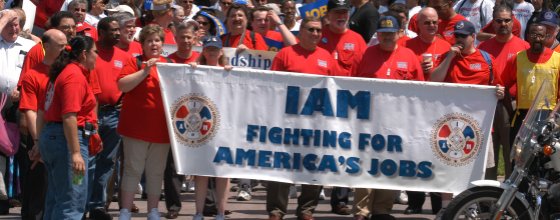
A complaint issued today by the National Labor Relations Board (NLRB) against the Boeing Co. is a victory for all American workers—particularly aerospace workers in both Puget Sound and South Carolina, officials with the Machinists (IAM) said.

NLRB Acting General Counsel Lafe Solomon issued the complaint, which alleges that Boeing’s decision in 2009 to locate a Dreamliner 787 final assembly line in North Charleston, S.C., represented illegal retaliation against IAM members who work for the company. The NLRB is seeking a court order requiring Boeing to operate the second 787 line, including supply lines, with union workers in the Puget Sound

“Boeing’s decision to build a 787 assembly line in South Carolina sent a message that Boeing workers would suffer financial harm for exercising their collective bargaining rights,” said IAM Vice President Rich Michalski.

Federal labor law is clear: It’s illegal to threaten or penalize workers who engage in concerted activity.

The decision by Boeing to locate the assembly line in South Carolina followed years of 787 production delays and an extraordinary round of mid-contract talks in which the IAM proposed an 11-year agreement to provide Boeing with the labor stability it claimed was necessary to keep 787 production in the Puget Sound area.

The board’s action reinforces the fact that “workers have a right to join a union, and companies don’t have a right to punish them for engaging in legal union activities,” said Tom Wroblewski, president of Machinists District Lodge 751 in Seattle, which represents Boeing workers.

Taking work away from workers because they exercise their union rights is against the law, and it’s against the law in all 50 states.

The board’s complaint comes in response to an unfair labor practice charge filed in March 2010 by District 751. Wroblewski added:

Had we allowed Boeing to break the law and go unchecked in their actions, it would have given the green light for corporate America to discriminate against union members and would have become management’s new strategic template to attack employees.

“A worker’s right to strike is a fundamental right guaranteed by the National Labor Relations Act,” the NLRB’s Solomon said.

We also recognize the rights of employers to make business decisions based on their economic interests, but they must do so within the law.

Seattle Theaters Showcase Union Support


by James Parks, Apr 20, 2011

With workers under attack across the nation, all the major theaters in the Seattle area affirmed their support for workers everywhere to organize and bargain collectively. In a statement, the 24 theatrical, sound and stagecraft employers, who all have contracts with the Theatrical Stage Employees (IATSE) Local 15, said:

We are proud to be a union employer. We are committed to bargain fairly and in good faith with our employees, and to maintaining our history of respect for, and cooperation with, the labor community.

Said Local 15 President Andrew Willhelm:

This says loud and clear that Seattle is still a union town. Just as in Wisconsin, the public supports labor. We’re doing all we can to make sure that corporate interests don’t hijack our government, the way they have in Wisconsin.

In addition to signing the statement, Seattle theaters joined in the We Are One national day of action April 4 by putting up signs honoring their relationship with unions.

“Our theatrical employers share our vision for social justice,” said Bess Sullivan, who chairs Local 15’s Defense Committee.

I spent a week at the State Capitol in Wisconsin with the thousands of public sector workers fighting back against union-busting, and we want to make a clear statement that we won’t tolerate that kind of attack in Washington.

“Our goal [on April 4] was to involve our members, and not just have a statement from our union,” said Amanda Quinn, a Seattle stagehand who coordinated the local’s We Are One actions.

We had our members raising issues with their coworkers and employers at their worksites, and planned an action at a location where many of our members work.

In addition to the 24 employers signing the Local 15 statement, the Seattle City Council unanimously passed a resolution reaffirming the city’s “support for public employees to organize and to bargaining collectively,” and opposed “any attempt to restrict or eliminate collective bargaining in the State of Washington.”

After 10 Years, Consolidated Biscuit Workers Will Vote on Union

Workers at Hearthside Food Solutions in McComb, Ohio, hand out information about joining a union.

by James Parks, Apr 20, 2011

After a decade of struggle, workers at cookie maker Consolidated Biscuit Company (CBC), now Hearthside Food Solutions (HFS), in McComb, Ohio, are a big step closer to joining a union. The National Labor Relations Board (NLRB) announced the 825 workers will vote May 5–6 on whether to join a union.

Fed up with low pay, minimal benefits and hazardous working conditions, workers at CBC approached the Bakery, Confectionery, Tobacco Workers and Grain Millers (BCTGM) about joining the union in 2001.

For Selena Smith Packer, a 15-year veteran at the plant, the issue is consistency.

Every time a new manager or a new owner takes over, they make changes for their interest, not ours. We have no vote or say in the matter. As a union, we’ll get to vote on changes and even make some demands that are in our best interest.

The NLRB overturned an initial election in 2002 because CBC had repeatedly violated federal labor laws. The labor board ordered the new election more than two years ago and the decision was affirmed by the U.S. Sixth Circuit Court of Appeals. Both the NLRB and the appeals court ruled that CBC harassed union organizing activities, and confused and scared workers into voting against joining BCTGM.

The court and board required CBC to reinstate employees Bill Lawhorn and Russell Teegardin in 2008, six years after the company fired them for trying to form a union. Lawhorn testified before Congress as an example of why the Employee Free Choice Act is necessary.

Fla. Nurses Win Union Voice; NNU Puts New Spin on Bad Govs


by Mike Hall, Apr 20, 2011

In Planation, Fla., registered nurses at Florida Medical Center voted overwhelmingly Tuesday to join the National Nurses Organizing Committee-Florida, an affiliate of the National Nurses United (NNU).

The 250 RN’s join the more than 5,000 Florida nurses in 14 hospitals around the state who have recently voted for a union voice to help them boost patient care. Says Delia Kan, an intensive care RN at the hospital:

Florida Medical Center RNs want to improve nurse-to- patient staffing in our hospital which will help us retain and recruit experienced nurses. RNs are gaining the power to have an effective independent voice in everyday patient care decisions that will improve the quality of care that our patients and our community deserve.

Also today, NNU announced a new online game show, Wheel of Misfortune. Unlike Wheel of Fortune where most of the slots are winners, there’s not a single winner on this wheel.

The game divides the Wheel of Misfortune into 10 slots, one each for the 10 worst governors in the natoon: Scott Walker of Wisconsin, Jan Brewer of Arizona, Tom Corbett of Pennsylvania, Rick Perry of Texas, Rick Scott of Florida, Paul LePage of Maine, Mitch Daniels of Indiana, Rick Snyder of Michigan, Chris Christie of New Jersey, and John Kasich of Ohio.

You won’t walk away with a bundle of cash when you spin this wheel. Instead you’ll have a chance to solve the puzzle of just who is America’s worst governor. Even if you buy a vowel, that’ll be a tough job.

Each time you spin the wheel and it stops on one of the governors, you’ll find a treasure trove of frightening facts. Some are well-known–like Walker’s and Kasich’s elimination of collective bargaining rights for public employees. But others are more obscure. Did you know Perry packs a Ruger .380 and calls Social Security a “ponzi scheme”? Or that Brewer eliminated state funding for low-income patients in need of organ transplants and wants to drop 250,000 Arizonians from Medicaid? Click here to take spin the wheel.