by Mike Hall, May 16, 2011
Last week the DREAM Act—which would give conditional legal status and eventual citizenship to undocumented students who meet a series of stringent criteria—was reintroduced in Congress.
Click here to read Dissent Magazine’s Daniel Altschuler’s detailed look at how young “DREAMERS” built a movement that has played a key role in keeping the DREAM alive since the bill was first introduced in 2002.

Tuesday, May 17, 2011
IAM Ratifies Pact with Army Fleet Support—and More Bargaining News
by Belinda Boyce, May 16, 2011
The Machinists (IAM) approved a new contract with Army Fleet Support, and more news from the “Bargaining Digest Weekly.” The AFL-CIO Collective Bargaining Department delivers daily, bargaining-related news and research resources to more than 1,300 subscribers. Union leaders can register for this service through our website, Bargaining@Work.
SETTLEMENTS
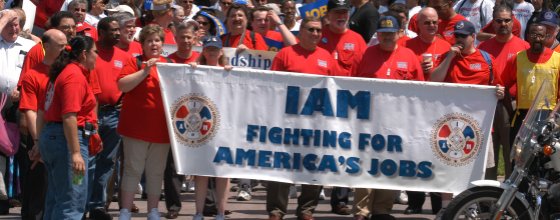
IAM, Army Fleet Support: Members of Machinists (IAM) Local 2003 at Ft. Rucker, Ala., ratified a new three-year contract with Army Fleet Support earlier this month. The 3,800 IAM members are trainers, test pilots and mechanics at the Army’s largest helicopter base.
WORK STOPPAGES & LEGAL ACTIONS
Multiple, American Red Cross: A National Labor Relations Board (NLRB) administrative law judge ruled that the American Red Cross Great Lakes Blood Services Region and mid-Michigan Chapter violated labor law in the ongoing dispute with Teamsters (IBT) Local 580 and Office and Professional Employees (OPEIU) Local 459. The Red Cross has more than 30 expired collective bargaining agreements across the country and is facing similar unfair labor practice charges in other regions.
BCTGM, Roquette America: Workers locked out more than six months ago by Roquette America in Keokuk, Iowa, participated in a “Monster Picket,” last Friday the 13th. Last September, the 237 members of Bakery, Confectionery, Tobacco Workers and Grain Millers (BCTGM) Local 48G rejected a “last and final” offer proposed by the company after only two weeks of bargaining.
NEGOTIATIONS
Multiple, State of Connecticut: Unions representing 45,000 Connecticut state workers have reached a tentative four-year deal that guarantees no layoffs (those announced last week will be rescinded) while saving the state $1.6 billion. The State Employees Bargaining Agent Coalition (SEBAC), comprised of the 15 unions that represent state workers, and the Gov. Daniel P. Malloy (D) administration agreed to not publicize details of the deal until members have been briefed.
TWU, American Airlines: Negotiators for the Transport Workers (TWU) rejected an offer from American Airlines, saying the proposal was worse than one rejected by the mechanics and store clerks bargaining units last summer. TWU said its request to be released from mediation was denied by the federal mediator.
AFA-CWA, US Airways: The Flight Attendants-CWA (AFA-CWA) and US Airways will begin federal mediation this week, after five years of negotiations have failed to result in a deal. AFA-CWA hopes the involvement of a federal mediator will improve the pace of bargaining.
CWA, Cincinnati Bell Inc.: Communications Workers of America (CWA) locals 4400 and 4401 in Ohio have reached a tentative 39-month agreement with Cincinnati Bell Inc. The deal covers 1,000 workers and includes a commitment by the company to keep jobs in Cincinnati.
Disclaimer: This information is being provided for your information only. As it is compiled from published news reports, not from individual unions, we cannot vouch for either its completeness or accuracy; readers who desire further information should directly contact the union involved.
Sunday, May 15, 2011
Illinois Education Reform Bill Passes With Union Support, For The Most Part

Joy Resmovits
Joy.resmovits@huffingtonpost.com
First Posted: 05/13/11 05:36 PM ET Updated: 05/13/11 05:41 PM ET
What’s next for Illinois teachers?
Following the passage of sweeping education reform, advocates, lawmakers and teachers unions are breathing a tempered sigh of relief, while also working to tie up some loose ends.
On late Thursday, a bill that drastically overhauls the teaching profession cleared the state’s House.
The bill, which now needs only the signature of Gov. Pat Quinn (D), a supporter, to pass into law, would make tenure contingent on student achievement, make it harder for teachers to call a strike and allow Chicago’s Mayor-elect Rahm Emanuel to lengthen his city’s school day. The bill makes it easier to dismiss teachers deemed ineffective based on student achievement. They would be rated on quality instead of years spent in the classroom.
The bill is one of many such measures sweeping state legislatures this year, as more local governments seek to tie teacher tenure to student scores.
But unlike similar bills in Wisconsin or Indiana, the teachers unions helped craft it.
While the end product isn’t entirely complete, Dan Montgomery, president of the Illinois Federation of Teachers, said he was proud of the process. “Everywhere else around the country, it’s reform done to teachers, not with teachers,” he told The Huffington Post in a phone interview. “This is different. We had serious, serious input on how this law works on every page of it.”
The general cooperation of teacher unions, Montgomery said, led to some concessions in their favor. “Here’s a big one: They wanted to end collective bargaining and the right to strike,” Montgomery said. “We got rid of that. It would have grotesquely ended negotiations, effectively ending teachers’ ability to advocate for kids. “
“It sends a good message in a year where there’s been a fair amount of polarization,” said Jonah Edelman, CEO and founder of advocacy-group Stand for Children. “You can achieve monumental breakthroughs without a monumental battle.”
Stand for Children, an education-reform advocacy group, helped set the stage with coalition building and a widely adapted “Illinois Performance Counts” agenda. Edelman interviewed 18 state candidates and supported nine with donations totaling $650,000.
“The Illinois breakthrough is very significant nationally,” Edelman said. “In a state with traditionally the most powerful … unions that typically have been very effective at shutting down any significant reforms, to move this forward with a significant amount of union cooperation is just amazing.”
But it wasn’t smooth sailing the entire way through.
Chicago Teachers Union president Karen Lewis is a union hand involved in crafting the bill, but she said she only agreed to participate in order to prevent more severe outcomes. “There’s Wisconsin, there’s Indiana, there’s Pennsylvania, Ohio. This is going nationwide,” she told WBEZ radio. “We’re trying to ameliorate some of the worst parts of what that bill had.”
And two unions, the CTU and the Illinois Federation of Teachers, backed out at the last second in response to a provision they said last week they found had been added. They took issue with a provision that would affect an ongoing lawsuit and also make it harder for them to call a strike, Montgomery said.
"We are disappointed that the House didn't wait until we could finalize language that will fix the problems with the bill," Montgomery said in a statement. "We are currently working with all the stakeholders to finish a follow-up bill, and we believe we are making progress.”
Montgomery was referring to a “trailer bill,” which, if passed, would be tacked on to alter some of the initial bill's technicalities.
But Edelman said the union dispute was just politics. “The rhetoric about seeing things slipped in is just a joke. That’s just baloney,” he said, adding that the unions saw the final draft, but may have missed the offending passage. “But the desire for technical fixes like the fair share numbers is legitimate.”
Montgomery shot back: “He wouldn’t know, he wasn’t there. I was.”
The trailer bill would aim to clarify the number of teachers required to call a strike: As it stands, the bill could be interpreted to mean that 75 percent of all teachers, including all “fair share” members -- those who opt out and have no vote -- must vote to call a strike. According to Edelman, the denominator intended to point to 75 percent of all bargaining units. “To not include the fair share members makes some sense,” he said.
Edelman added he’s not sure if the bill would ultimately bring CTU back into the fold. “We’ve agreed to certain technical fixes, but we don’t know if it’ll result in the Chicago Teachers Union getting back on board,” Edelman said.
CTU did not return requests for comment.
Labor Dept. App Helps Workers Track Wages, Hours

by James Parks, May 15, 2011
Want to make sure you’re getting paid what you’re due? Now there’s an app for that. The U.S. Labor Department announced last week its first application for smartphones: a time sheet to help employees independently track the hours they work and determine the wages they are owed.
Available in English and Spanish, workers can use the application to conveniently track regular work hours, break time and any overtime hours for one or more employers. Contact information and materials about wage laws are easily accessible through links to the webpages of the department’s Wage and Hour Division.
Rather than relying on their employers’ records, workers now can keep their own. Workers also will be able to add comments on any information related to work hours and see a summary of work hours for the day, week or month and e-mail a summary of hours and pay as an attachment. This information could prove invaluable during a Wage and Hour Division investigation when an employer has failed to maintain accurate employment records.
Labor Secretary Hilda Solis says:
I am pleased that my department is able to leverage increasingly popular and available technology to ensure that workers receive the wages to which they are entitled. This app will help empower workers to understand and stand up for their rights when employers have denied their hard-earned pay.
The free app is currently compatible with the iPhone and iPod Touch. The Labor Department is exploring updates that could work on other smartphone platforms, such as Android and BlackBerry. It also is looking into other pay features not currently provided for, such as tips, commissions, bonuses, deductions, holiday pay, weekend pay, shift differentials and pay for regular days of rest.
For workers without a smartphone, the Wage and Hour Division has a printable work hours calendar in English and Spanish to track rate of pay, work start and stop times, and arrival and departure times. The calendar also includes easy-to-understand information about workers’ rights and how to file a wage violation complaint.
Both the app and the calendar can be downloaded from the Wage and Hour Division’s website at www.dol.gov/whd. For more information about federal wage laws or to order a calendar by mail, call the division’s helpline at 866-4US-WAGE (866-487-9243).
Workers Come Out Strong At End of Missouri Legislative Session
by Tula Connell, May 14, 2011
Missouri AFL-CIO President Hugh McVey and Secretary-Treasurer Herb Johnson wrap up the outcome of the state’s legislative session.
The first session of the 95th General Assembly of Missouri ended at 6 p.m., May 13. The session began with the emotional fervor of the majority Republican party proclaiming great changes they would make in the state during the upcoming legislative session.
Among those issues were those that were political in nature, bills that would produce no employment and create no economic gains for our state. Those bills were simply meant to reduce the capacity of labor unions to advocate for our members and so reduce the participation of working people in the political process in our state.
SB 1, a so-called Right to Work bill, would have produced not one job but would have ultimately created a lower standard of living for all. Fortunately, the bill lacked the support of the more learned and prudent members of the Missouri Senate and even less support in the Missouri House of Representatives and did not pass.
SB 202, a so-called paycheck protection bill, would have singled out labor union members requiring their annual written authorization for payroll deduction to the union political pact. No other entity would have been required to do so because employers would have been provided a loophole in the bill to avoid its limitations. The bill failed to gain the necessary support, and did not pass.
HJR 6, a bill that would have required an election for union representation even if a majority of employees had signed a petition for representation and even if the employer had voluntarily recognized and accepted their petition, failed to gain the necessary support in the General Assembly did not pass.
HB 473, a bill that would have expanded charter schools at the expense of the public school system and threatened to eliminate teacher tenure (seniority and due process), did not pass.
SB 175, a bill that would have eliminated project labor agreements that provides our building trades with good quality work, was not considered.
SB176, HB 828, and HB 138, bills that would have eliminated and or restricted prevailing wage, did not pass.
We also opposed an attempt to eliminate Missouri’s Minimum Wage and a bill that would that would have allowed employers to escape their rightful liabilities for exposure to occupational health hazards such as asbestosis, mesotheleoma and others. We are grateful these bills failed to obtain the necessary support and therefore did not pass.
In addition, Governor Nixon vetoed SB 188. This bill would have severely reduced human rights in the Missouri workplace.
It is unfortunate that some Missouri Business interest’s prevented the passage of legislation to replenish the workers compensation second injury fund, which pays benefits awarded to injured workers and their families. The failure to act leaves more than a thousand Missouri families without income and our state potentially liable, for those court ordered benefits.
To the extent we were successful in defending our rights and privileges under Missouri law it is due to the solidarity of the trade union movement of our state and also to the support of the members of the House and Senate from both parties, who stood with us on behalf of working families. It is a privilege to represent the labor movement in the Democratic process of the state of Missouri.
UCS Sponsors ‘Unions Now, More Than Ever’ Contest

by Mike Hall, May 14, 2011
We all know that with the ongoing assault on the middle class and on workers’ rights, people need unions now more than ever. Now you have a chance to say why and pocket a bit of much-needed cash in this time of high unemployment, stagnant wages and rising prices.
Union Communication Services (UCS) is holding a “Unions Now, More Than Ever” contest with $2,500 in prizes for videos, graphics, cartoons and songs speaking to that theme. UCS publisher David Prosten says:
We keep hearing that unions really aren’t necessary anymore. But in the current economic climate and with increasing attacks on workers and their unions, it’s clear that workers need unions now, more than ever.
Tell the tens of thousands of workers killed or injured on the job last year that they don’t need a union, or the dozens of immigrants found locked into a Los Angeles factory compound, forced to spend 16 hours a day virtually chained to sewing machines. Tell the hundreds of thousands of retail workers bullied into working off the clock they don’t need the voice at work a union provides.
Submissions can be made in three categories:
•VIDEO—2-minute maximum length, must be posted on YouTube;
•GRAPHIC/CARTOON— jpg format, 300 DPI;
•SONG—3-minute maximum length in MP3 format.
All entries must include the tagline, “Unions Now, More Than Ever” and must be English-language. Send e-mail entries to contest@unionist.com. Deadline for entries is Aug. 1; winners in each category will be announced the week before Labor Day. A total of $2,500 in prizes will be awarded: three 1st prizes of $500 (one in each category) and four 2nd prizes of $250 (at least one in each category).
Winners will be featured by UCS— www.unionist.com—which has been providing information and ammunition for union activists since 1981. UCS is the Annapolis, Md.-based publisher of communications and educational tools for labor leaders and members and publishes the Union Steward’s Complete Guide, Steward Update Newsletter, a catalog of hard-hitting books for union activists, weekly news and graphics services for union communicators and more, including online steward training.
Fifth Wisconsin University Faculty Votes for Union

by James Parks, May 13, 2011
Despite the ongoing attacks on workers’ rights in the state, the University of Wisconsin-Green Bay (UWGB) faculty today voted 117– 2 for representation by AFT. This is the fifth UW campus to do so since Gov. Scott Walker’s plan to eliminate public employee bargaining was introduced.
Although Walker’s anti-worker bill now is being challenged in court, Republican lawmakers have said they intend to include its anti-collective bargaining provisions in the state budget, which already calls for drastic funding cuts to the University of Wisconsin system.
Aeron Haynie, an associate professor of English and humanities, says the faculty vote ties in to the burgeoning labor movement in Wisconsin. The movement has gained incredible momentum since the announcement of Walker’s anti-union bill in February, she says.
I’m proud to vote for a faculty union at UWGB. As we have seen this past year in Wisconsin, it is vital that working people join together and fight for our rights—our right to make decisions which affect the quality of education here in our state, and our right to decent benefits. Working together, as a union, makes our voices stronger.
University of Wisconsin faculty and academic staff were extended the right to collectively bargain in June 2009. Since then, faculty at six other campuses—UW-Eau Claire, UW-Superior, UW-La Crosse, UW-Stout, UW-River Falls and UW-Stevens Point—have voted in favor of collective bargaining representation. UW-Superior academic staff will vote on union representation next week.
Saturday, May 14, 2011
After Three Years, Reynolds Agrees to Meet with Tobacco Workers

by James Parks, May 13, 2011
In a major turnaround, officials of Reynolds American, who have refused for three years to meet with representatives of tobacco workers, agreed last week to look into the labor practices in their supply chain and work with other parties, including the Farm Labor Organizing Committee (FLOC) to ensure they are not complicit with human rights violations.
More than 50 FLOC members entered the Reynolds American shareholders’ meeting last week in Winston-Salem, N.C., to deliver a report on the horrible conditions in the fields. Nearly 100,000 immigrant tobacco workers in North Carolina are paid sub-minimum wages and are exposed to dangerous conditions in the fields.
The FLOC representatives pressed company executives to ensure that this new stance is more than just words and is backed up with serious action, including meeting with farmworkers and their representatives. No date for a meeting has yet been set.
In a statement, FLOC said:
While this represents a vindication of the past three years of struggle, the campaign will continue until real progress is made in the supply chain of tobacco giant Reynolds American.
Late last month, the workers gained another major victory when executives of British American Tobacco (BAT), which owns 42 percent of Reynolds American, agreed to meet with FLOC later this month. This is the first time any corporation with close ties to Reynolds American has agreed to meet with workers.
Farm workers, union members and members of the Labor Council for Latin American Advancement (LCLAA) also protested at the British Embassy in Washington, D.C., and at British consulates in nine cities in support of the tobacco workers.
GOP Attack on NLRB Goes Viral

Thu. May 12, 2011
The right-wing screech-fest over the National Labor Relations Board (NLRB) complaint against Boeing is reaching circus-like proportions, with conservative commentators and Republican presidential candidates competing to see who can make the most outrageous and incendiary remarks about the case.
The always reliable anti-union demagogue from South Carolina, Republican Senator James DeMint, blasted the complaint against Boeing as “thuggery” and “ something you would expect in a Third World country, not in America.” Meanwhile, South Carolina Republican Governor and Tea Party darling Nikki Haley describes the complaint as nothing less than an attack on the American free-enterprise system, a sentiment echoed by Boeing CEO James McNerney in a Wall Street Journal editorial.
It was left to Iowa Sen. Tom Harkin to restore sanity to the controversy with a statement describing what he called the GOP’s mission of misinformation.
“This overly dramatic response and the disturbing misinformation they are peddling has needlessly complicated the legal process and distorted the public discussion of this case,” said Harkin. “Unions are one of the few voices left in our society speaking up for the little guy, and if we let powerful CEOs trample all over these rights without consequences, we might as well give up on having a middle class altogether.”
Sen. Harkin, who serves as Chairman of the Senate Health, Education, Labor and Pensions Committee, also held a hearing this week where he grilled Boeing’s General Counsel about the unprecedented and virulent opposition among Republican lawmakers against the NLRB. A video of the hearing is available here: http://help.senate.gov/hearings/hearing/?id=bf9cac77-5056-9502-5d75-3499b6f85bd2
Boeing Exec Says $3.7 Mil Not Enough

Boeing Co. Executive Vice President and General Counsel Michael Luttig pulled in $3.7 million in compensation in 2009. That’s a whopping 34 percent increase from 2008—and it came during a major recession.
Meanwhile, as Sen. Tom Harkin (D-Iowa) pointed out during a hearing yesterday (see video) on the shrinking American middle class, Boeing’s workers have seen just a 3 percent increase in their average compensation over the past 20 years!
Harkin, chairman of the Senate Health, Education, Labor and Pensions Committee, wanted to know that if things were going so swimmingly for Boeing that Luttig could pocket a 34 percent pay hike,
Why shouldn’t employees have a share of that? I’m just asking about fairness for workers.
Luttig turned to the old let’s-duck-the-question-with-a-little-humor dodge. But his lame attempt at humor just showed how out of touch he is with the real-life, middle-class problem of stagnant wages.
Mr. Chairman, my compensation is a matter of public record. I have to say, at this very instant, I have the sense that maybe it’s not enough.
Tell that to Boeing’s workers.
BTW, Boeing CEO W. James McNerney Jr. isn’t doing too bad either. He made $19.7 million in compensation in 2010. By comparison, the median Boeing worker made $33,190 in 2010. McNerney Jr. made 594 times the median worker’s pay. Check out more on CEO pay at the AFL-CIO Executive PayWatch website.
Subscribe to:
Posts (Atom)


